
The actor Bruno Ganz’s portrayal of Adolf Hitler in the 2004 film “Der Untergang” (Downfall) remains a landmark in cinematic history, offering a deeply unsettling and complex depiction of the Nazi dictator. Based on historian Joachim Fest’s work and the recollections of those in Hitler’s inner circle, the film delves into the final days of the Third Reich within the confines of the Führerbunker. Ganz, already known for his role as an angel in Wim Wenders’ “Wings of Desire,” took on the monumental task of humanizing a figure responsible for unimaginable atrocities. This interpretation sparked considerable debate, particularly in Germany, questioning the ethical implications of presenting Hitler with human traits. Jasper Rees sat down with Bruno Ganz in Berlin to discuss his approach to this challenging role.
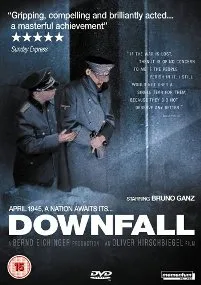 Bruno Ganz as Hitler
The Actor’s Preparation and Ethical Considerations
Ganz’s preparation for the role was extensive, relying heavily on witness accounts and historical records due to the scarcity of film and photographic evidence from Hitler’s final months. He noted that living in Berlin provided a crucial connection to the historical context, while his Swiss nationality offered a psychological distance, allowing him to embody Hitler without the direct burden of German complicity.
“It helped me also that I am not German because I could put my passport between Hitler and me,” Ganz explained. “And I have not this kind of problems like a lot of my German friends have, questioning their parents or grandparents what they did do in that time.”
A key aspect of his research involved observing individuals with Parkinson’s disease to authentically portray Hitler’s physical decline, including the tremor in his hand. This empathetic engagement with the human suffering caused by the illness was something Ganz felt deeply. “I was watching these people and I know how it feels to be watched all the time and they tried to hide it because they felt that someone was watching them. So I started to become like them.”
The decision to accept the role was not immediate. Ganz grappled with the potential for being forever identified with Hitler and the broader implications of humanizing such a figure. He recognized the public’s need for an “intact icon of the evil itself,” but questioned the very definition of pure evil. His research, however, led him to see Hitler not just as a detached monster, but as a figure deeply intertwined with the German people’s post-World War I humiliation and their desperate need for restored dignity.
Charisma, Manipulation, and the Power of Performance
Ganz observed that Hitler possessed a potent charisma, a chameleon-like ability to adapt his demeanor to his audience. He notes that Hitler offered a sense of dignity to a nation feeling deeply humiliated after World War I, promising salvation and acting decisively, which was unprecedented in politics at the time. This perception of Hitler as a man of action, a stark contrast to typical politicians, contributed to his rise and sustained support.
A crucial discovery for Ganz was a secretly recorded seven-minute audio tape of Hitler speaking calmly to a Finnish diplomat. This provided insight into a less public, more relaxed speaking voice, distinct from the bombastic orator seen in newsreels. “He’s talking to a Finnish diplomat. And he did not know that he was recorded. So he is very calm… As very often he is quite stupid,” Ganz recalled, highlighting Hitler’s self-proclaimed expertise across various domains as an “autodidact.” This calmer voice, Ganz found, sounded more human and intimate than the public speeches.
Ganz also noted Hitler’s Austrian accent, a blend of his native dialect and a learned military German. He recognized Hitler’s “courteous” Austrian mannerisms towards women, including kissing hands, a trait that pleased German women who found their own men less adept at such displays.
The actor also explored Hitler’s fascination with Richard Wagner, believing it stemmed from an early exposure to Wagner’s operas in Linz. Ganz suggested that Hitler felt a deep connection to the “Wagnerian world and imagination,” including Wagner’s anti-Semitic views, and was drawn to the theatricality, the actors, and the opera singers involved in such productions. While acknowledging Hitler’s artistic sensibilities, Ganz ultimately deemed him a “failure” as an artist due to a lack of talent, yet recognized his ability to use these theatrical elements effectively.
The Burden of History and the Nature of Evil
Ganz’s portrayal involved a form of self-suggestion, an ability to immerse himself in the character, though he distinguished his technical approach from Hitler’s fervent beliefs. He found Hitler’s hatred for Jews incomprehensible, a point of departure he could not fully ascertain.
The film itself touches on the Jewish question only once, through a mention by Albert Speer. Ganz deferred questions about this to the scriptwriter, emphasizing his focus on Hitler’s final days. His research in the bunker, as it were, involved extensive reading, observing Parkinson’s patients, and working with an Austrian dialect coach.
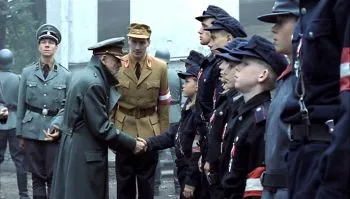 Hitler with generals
Ganz expressed reluctance towards impersonating historical figures, preferring to create fictional characters. He found the physical resemblance to Hitler, particularly with the addition of a wig, startling at first but ultimately helpful for the role. He managed to maintain a clear separation between himself and the character, avoiding method acting and the psychological burden of embodying Hitler off-set.
He recalled a difficult experience filming in St. Petersburg, where his resemblance to Hitler drew fearful and astonished reactions from locals, reminding him of the devastating impact of the blockade. This led him to appreciate filming in a controlled studio environment.
Ganz revealed that the resemblance was not entirely unexpected, having been remarked upon years earlier during a theatrical production. He received a letter from a doctor who had known Hitler, cautioning him against “chewing the carpet” and affirming that his portrayal was remarkably close to the real man. This validation was significant for Ganz.
The Spectacle of Evil and Human Complexity
The opening scene, depicting young women applying to be Hitler’s secretary, was intended by Ganz to illustrate the audience’s own “overpowering fascination” with such a figure. He aimed to convey Hitler’s strength and intelligence, suggesting that even fanaticism has roots in something tangible. He mused that Hitler could have been the founder of a new religion, drawing power from what might today be termed “spiritual sources.”
Despite the historical atrocities, Ganz sometimes felt a sense of pity for Hitler in his final moments, seeing him as a “stupid guy” who should have recognized his errors and the devastation he caused, particularly the genocide. However, he firmly maintained that Hitler, despite his actions, was a human being. He rejected the simplistic label of “monster,” particularly from those not directly affected, while respecting the perspective of Jewish survivors.
Ganz met with Jewish survivors in Los Angeles, finding them remarkably fair and willing to listen. He considers his role as Hitler one of the most important of his career, acknowledging director Oliver Hirschbiegel’s assertion that he had to explore the “evil within himself,” though Ganz remained uncomfortable with the abstract terms of “good” and “evil.”
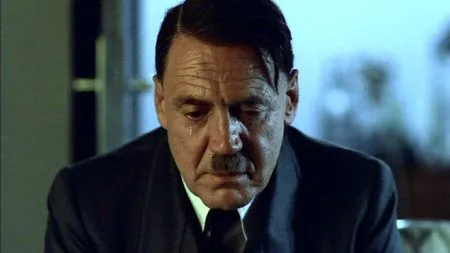 Hitler in the bunker
He saw Hitler’s success in attacking France, despite his generals’ objections, as a testament to his power as Führer. This audacity, akin to the legendary Baron von Münchhausen pulling himself out of mud by his own hair, allowed Hitler to overcome strategic doubts. Ganz could understand Hitler’s feeling of betrayal when his early associates, Himmler and Goering, seemingly abandoned him in his final days.
Regarding Hitler’s personal life, Ganz speculated that Hitler and Eva Braun may have had a sexual relationship only a few times. He also reflected on Joseph Goebbels’ cynical intelligence, recognizing his understanding of Nazism as partly “show business” and his manipulative use of media, while still being a committed believer.
Ganz, born shortly before the invasion of the Soviet Union, grew up in neutral Switzerland, with only distant memories of the war, such as his father’s extended military service and his mother’s trivial concerns about fruit shortages. He expressed a strong dislike for his mandatory military service.
Bruno Ganz passed away on February 16, 2019, leaving behind a powerful and enduring legacy, particularly through his unforgettable portrayal of Adolf Hitler in “Der Untergang.”